The U.S. Census Bureau and “Super Intelligence”
The Census Bureau’s shift from asking about AI to “Super Intelligence” in its Business Trends and Outlook Survey changes the data’s comparability and raises questions about future AI adoption metrics.
Introduction
In a recent post, Simon Willison highlighted a subtle but consequential change in the U.S. Census Bureau’s Business Trends and Outlook Survey (BTOS). The survey, which tracks AI adoption across U.S. firms, altered its core question in late 2025 and again in October 2026 to reference “Super Intelligence” (SI) instead of “Artificial Intelligence” (AI). This editorial examines why the wording matters, how it affects the data, and what readers should watch for in upcoming releases.
How the BTOS works and why it matters
The BTOS samples 200,000 businesses every two weeks, rotating through a panel of 1.2 million firms so that each respondent participates roughly once every twelve weeks. The survey’s timing—published on alternating Thursdays at 10 a.m.—makes it a reliable barometer for corporate technology trends. Analysts, investors, and policymakers have relied on its AI adoption figures to gauge the pace of digital transformation in large enterprises.
The evolution of the survey question
From “producing goods or services” to “any business function”
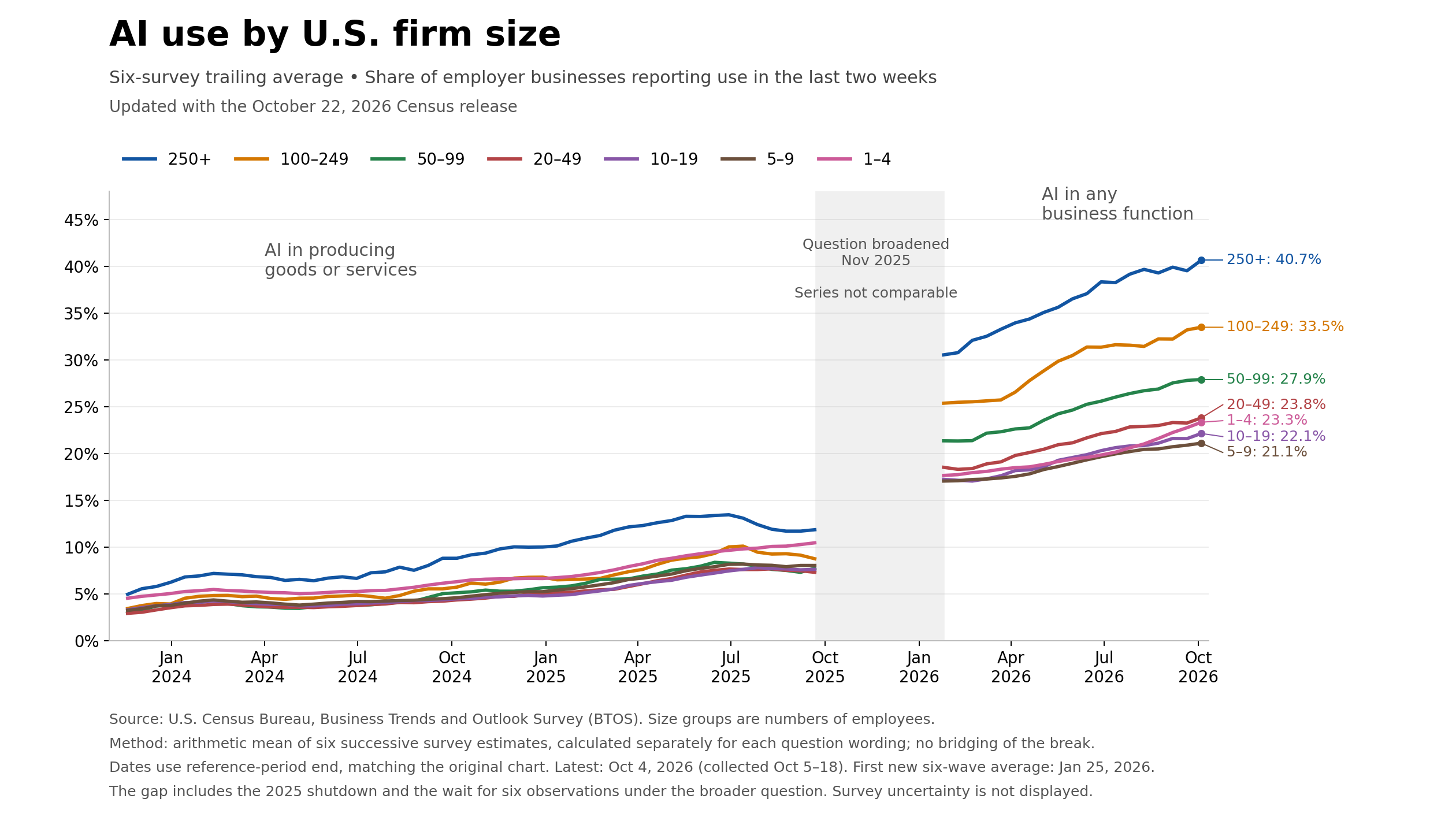
Until November 17 2025, the BTOS asked respondents:
In the last two weeks, did this business use Artificial Intelligence (AI) in producing goods or services?
On December 3 2025 the Bureau broadened the scope to:
In the last two weeks, did this business use Artificial Intelligence (AI) in any of its business functions?
The change alone inflated reported adoption rates: large firms (250+ employees) rose from roughly 12 % saying “yes” in September 2025 to about 30 % by February 2026, and 40 % by October 2026. The broader wording captured uses in marketing, coding, forecasting, and other non‑production activities, making direct year‑over‑year comparisons misleading.
The jump to “Super Intelligence”
In the October 19 2026 collection, the Bureau introduced a new term:
In the last two weeks, did this business use Super Intelligence or SI (formerly referred to as Artificial Intelligence or AI) in any of its business functions?
The shift was mandated by Executive Order 14434, which calls for clearer terminology around advanced AI systems. The survey’s help text now lists examples such as “SI‑powered data analysis” and “generative SI for marketing, product design, or coding.” The first results using this wording are slated for release on the next Thursday publication.
Implications for data users
- Comparability breaks – Because the question’s scope and terminology have changed twice, historical trends must be re‑anchored. Analysts should treat pre‑December 2025 data as a baseline for production‑focused AI use, and post‑December 2025 data as a broader indicator of AI integration.
- Potential respondent confusion – Survey participants last saw the AI‑focused wording twelve weeks earlier. Even with the clarifying note “formerly referred to as Artificial Intelligence or AI,” some firms may misinterpret the new term, leading to either over‑reporting (if they assume any AI‑related tool qualifies) or under‑reporting (if they view SI as a distinct, more advanced technology they do not yet possess).
- Signal of policy influence – The Executive Order’s impact on a federal statistical instrument underscores how government directives can shape the language of data collection, and consequently, the narrative around technology adoption.
What to watch in the next release
- Response rates – A dip or spike could indicate how quickly businesses adapt to the new terminology.
- Sector‑level breakdowns – Early adopters in tech‑heavy sectors may show higher SI usage, while traditional manufacturing may lag, revealing where the “Super Intelligence” label resonates.
- Cross‑validation with other datasets – Comparing BTOS SI figures with private surveys (e.g., from consulting firms) can help triangulate the true state of advanced AI deployment.
Practical takeaways
- When citing Census AI adoption numbers, always note the survey version and wording used.
- For longitudinal analyses, consider normalizing the data to a common definition (e.g., “any AI‑enabled function”) or segmenting the timeline at each wording change.
- Keep an eye on the forthcoming Thursday release; it will be the first benchmark for SI adoption and may set a new baseline for future trend analysis.
--- Simon Willison’s original post, dated 2 November 2026, provides the raw BTOS files and a snapshot of the questionnaire for readers who want to dig deeper into the numbers.
Source
Read original sourceWhy we picked this
Discusses AI adoption trends and policy impact, relevant but not core tech