The missing quadrant in responses to AI
STABL argues that AI’s transformative power and the institutional bottlenecks shaping its impact belong together in a neglected top‑right quadrant, and outlines a research agenda to measure recursive self‑improvement, broaden risk defenses, and steer economic outcomes.
The Missing Quadrant in Responses to AI
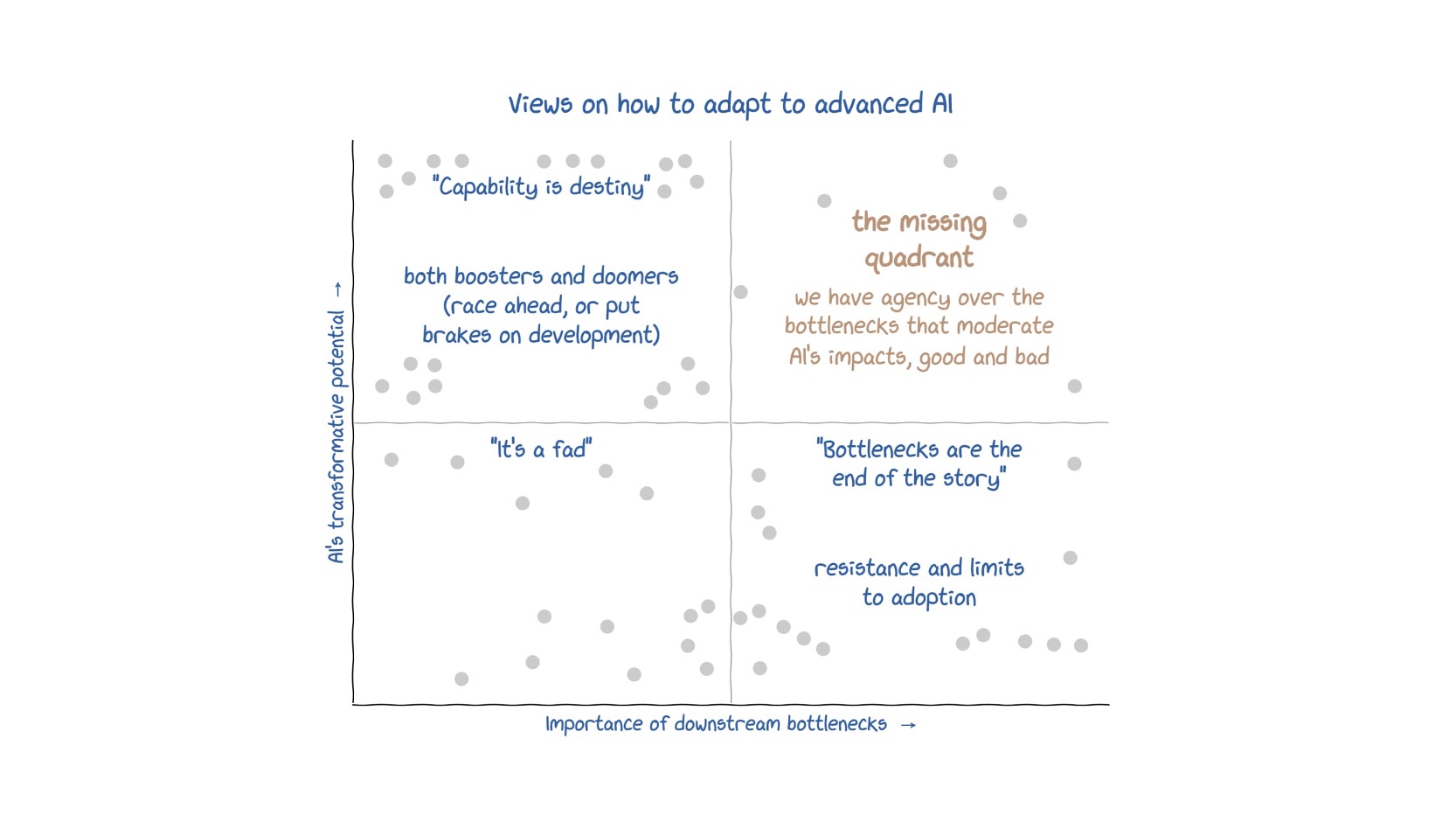
Advanced AI is undeniably a general‑purpose technology with the potential to reshape societies. Yet most public debates sit at opposite extremes: technological determinism, which assumes AI will bulldoze through any institutional barrier, and bottleneck‑first thinking, which treats existing structures as immutable and tries to fit AI into them. The authors of STABL (Societal Transformation and AI Bottlenecks Lab) propose a third, under‑explored space—the top‑right quadrant of a 2×2 framework—where we take both AI’s transformative potential and downstream bottlenecks seriously. This perspective informs a research agenda that blends capability tracking with institutional reform, aiming to build a resilient, inclusive transition.
---
1. Why the Top‑Right Quadrant Matters
- Balanced Viewpoint: Recognizing that AI can accelerate change while also acknowledging that regulations, professional norms, and organizational inertia shape how that change manifests.
- Avoiding Polarisation: By refusing to treat AI as either an unstoppable force or a harmless tool, the quadrant encourages dialogue between technologists, policymakers, and civil‑society actors.
- Strategic Leverage: Understanding bottlenecks is only the first step; the real work lies in redesigning those bottlenecks—e.g., faster clinical‑trial pipelines or adaptive regulatory sandboxes—to unlock AI’s benefits.
---
2. Measuring Progress Toward Recursive Self‑Improvement (RSI)
Recursive self‑improvement—AI systems that autonomously advance AI research—underpins many forecasts of rapid, explosive capability growth. STABL suggests a more nuanced empirical approach:
- Open‑Ended Evaluations: Move beyond narrowly verifiable benchmarks to tasks that require creativity, long‑term planning, and scientific reasoning.
- Causal Model Comparison: Test competing theories about how performance on clean, data‑rich tasks translates (or fails to translate) into real‑world impact.
- Dimensional Disaggregation: Separate progress on verification‑friendly metrics from gains on ambiguous, open‑ended problems to see where RSI truly gains traction.
A diversified research ecosystem that includes skeptics and optimists alike can surface hidden assumptions and provide early warnings about the trajectory of AI capabilities.
---
3. Expanding the AI‑Risk Playbook Beyond Alignment
Traditional AI safety focuses on model alignment and non‑proliferation. STABL argues that a robust defense must also incorporate three complementary pillars:
- Control & Monitoring: Build tools that can intervene, audit, and shut down systems that behave unexpectedly, even when alignment fails.
- Downstream Defenses: Harden critical infrastructure—healthcare, energy, finance—against AI‑enabled attacks, recognizing that the attack surface expands as AI becomes ubiquitous.
- Societal Resilience: Develop sector‑specific contingency plans, invest in large‑scale cyber‑defense, and practice worst‑case scenario planning (e.g., coordinated AI‑driven disinformation or supply‑chain disruption).
Resilience, often mentioned only in theory, becomes actionable when framed with concrete sector goals, ambitious funding targets, and clear recovery protocols.
---
4. Steering Economic Impacts and Institutional Adaptation
AI adoption is visible across firms, yet macro‑level benefits remain elusive and job‑loss narratives dominate public discourse. STABL’s economic research agenda includes:
- Benefit‑Cost Accounting: Systematically measure productivity gains, cost savings, and new market creation versus displacement effects.
- Labor‑Market Dynamics: Track skill mismatches, upskilling pathways, and the timing of wage adjustments to inform policy interventions.
- Institutional Innovation: Experiment with adaptive regulatory frameworks (e.g., AI‑specific sandboxes) that can evolve as capabilities change, rather than relying on static rules.
By integrating quantitative impact studies with institutional design, policymakers can shape a transition that maximises upside while mitigating downside risks.
---
5. A Call to Collaborative Action
STABL does not claim to be the sole voice in the top‑right quadrant; rather, it seeks to catalyse a broader intellectual community that bridges the technology‑first and bottleneck‑first camps. Practical steps include:
- Cross‑Sector Partnerships: Co‑design research projects with regulators, industry consortia, and civil‑society groups.
- Open‑Source Toolkits: Release frameworks for resilience assessment, RSI benchmarking, and economic impact modeling.
- Public Engagement: Use newsletters, workshops, and policy briefs to keep the conversation inclusive and evidence‑driven.
---
Closing Thoughts
The future of AI will be shaped not just by how fast models improve, but by how societies adapt their institutions, safeguards, and economic structures. By occupying the neglected top‑right quadrant, STABL highlights a pragmatic pathway: measure AI progress, redesign bottlenecks, and build resilient systems. This balanced approach offers a roadmap for stakeholders who want to harness AI’s promise without surrendering to either fatalistic optimism or paralyzing conservatism.
Source
Read original sourceWhy we picked this
Discusses societal and policy aspects of AI, fitting meaningful AI news.