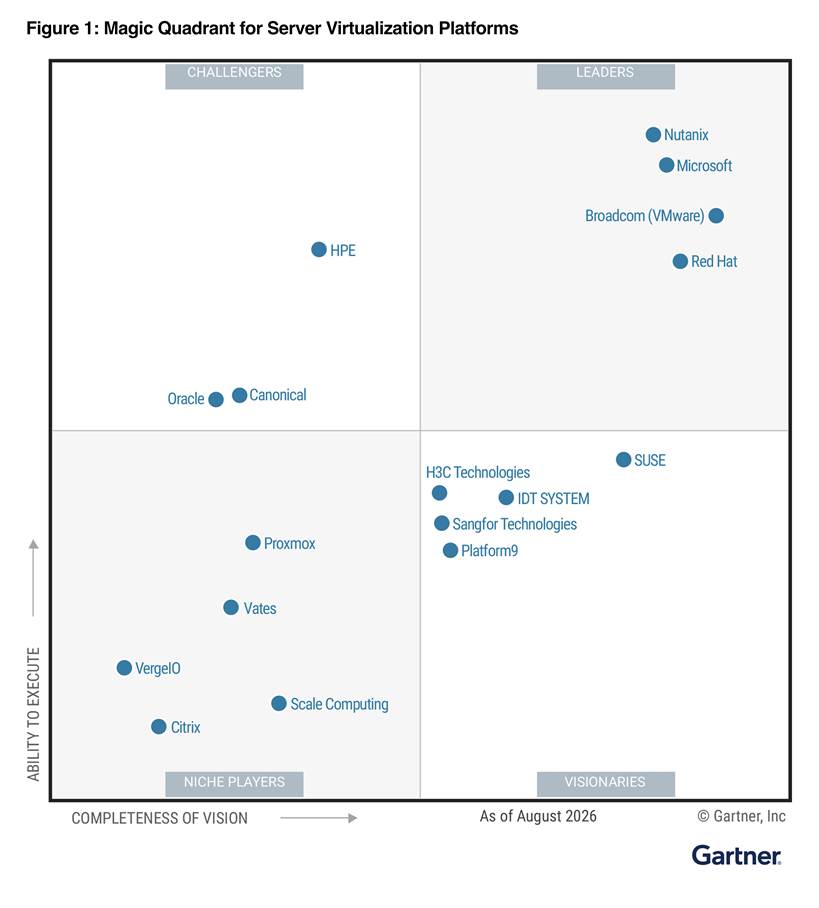
Microsoft named a Leader in the 2026 Gartner® Magic Quadrant™ for Server Virtualization Platforms
Microsoft’s placement as a Leader in Gartner’s 2026 Magic Quadrant for Server Virtualization Platforms underscores its focus on operational and infrastructure consistency across cloud, datacenter, edge, and sovereign environments.
Introduction
Microsoft has been recognized as a Leader in Gartner’s 2026 Magic Quadrant for Server Virtualization Platforms. The accolade arrives at a pivotal moment for enterprise IT, where the conversation has shifted from selecting a hypervisor to establishing a unified operating model that spans cloud, on‑premises, edge, and sovereign workloads. Microsoft’s strategy hinges on two complementary pillars: operational consistency via Azure and Azure Arc, and infrastructure consistency through Hyper‑V.
Operational Consistency Across Distributed Environments
Azure provides a common set of management, governance, and security capabilities that apply uniformly to resources in the public cloud, private datacenters, and edge locations. Azure Arc extends this model, allowing organizations to apply Azure‑based policies, monitoring, and compliance controls to any infrastructure—whether it runs on third‑party clouds, on‑premises servers, or specialized edge hardware. This unified control plane reduces the operational overhead of maintaining separate toolchains for each environment and enables a single source of truth for compliance and security posture.
Infrastructure Consistency with Hyper‑V
Hyper‑V serves as the virtualization foundation that underpins Azure, Azure Local, and Windows Server. By offering a consistent hypervisor across these platforms, Microsoft ensures that workloads can move seamlessly between cloud, on‑premises, and edge locations without requiring extensive re‑architecting. This consistency preserves customer choice while simplifying lifecycle management, patching, and performance tuning across heterogeneous environments.
Why Consistency Matters in the Age of AI
As artificial intelligence workloads become more pervasive, the underlying infrastructure must support rapid data movement and model deployment across a dispersed landscape. AI workloads often span multiple regions, edge devices, and sovereign clouds, amplifying the need for a single management framework. Microsoft’s dual focus on operational and infrastructure consistency positions organizations to adopt AI technologies without compounding the complexity of their existing distributed systems.
Looking Ahead
The recognition from Gartner reflects a broader industry trend toward unified infrastructure management. Enterprises are increasingly seeking platforms that allow them to run workloads wherever they choose while maintaining a single, coherent operational model. Microsoft’s continued investment in Azure, Azure Arc, and Hyper‑V signals its commitment to meeting this demand, enabling customers to innovate faster and manage risk more effectively.
--- Microsoft’s leadership in the 2026 Gartner Magic Quadrant highlights the importance of a consistent, cross‑environment approach to server virtualization—a strategy that is likely to shape the future of enterprise IT.
Source
Read original sourceWhy we picked this
AI relevance scoring was unavailable; retained a source-matched candidate for manual review.