Language Models for Text Classification: From Bag-of-Words to Jev
The article traces text classification from bag‑of‑words models through deep neural nets to the versatile Jev API, highlighting why Jev’s speed, cost, and generality make it a compelling modern classifier.
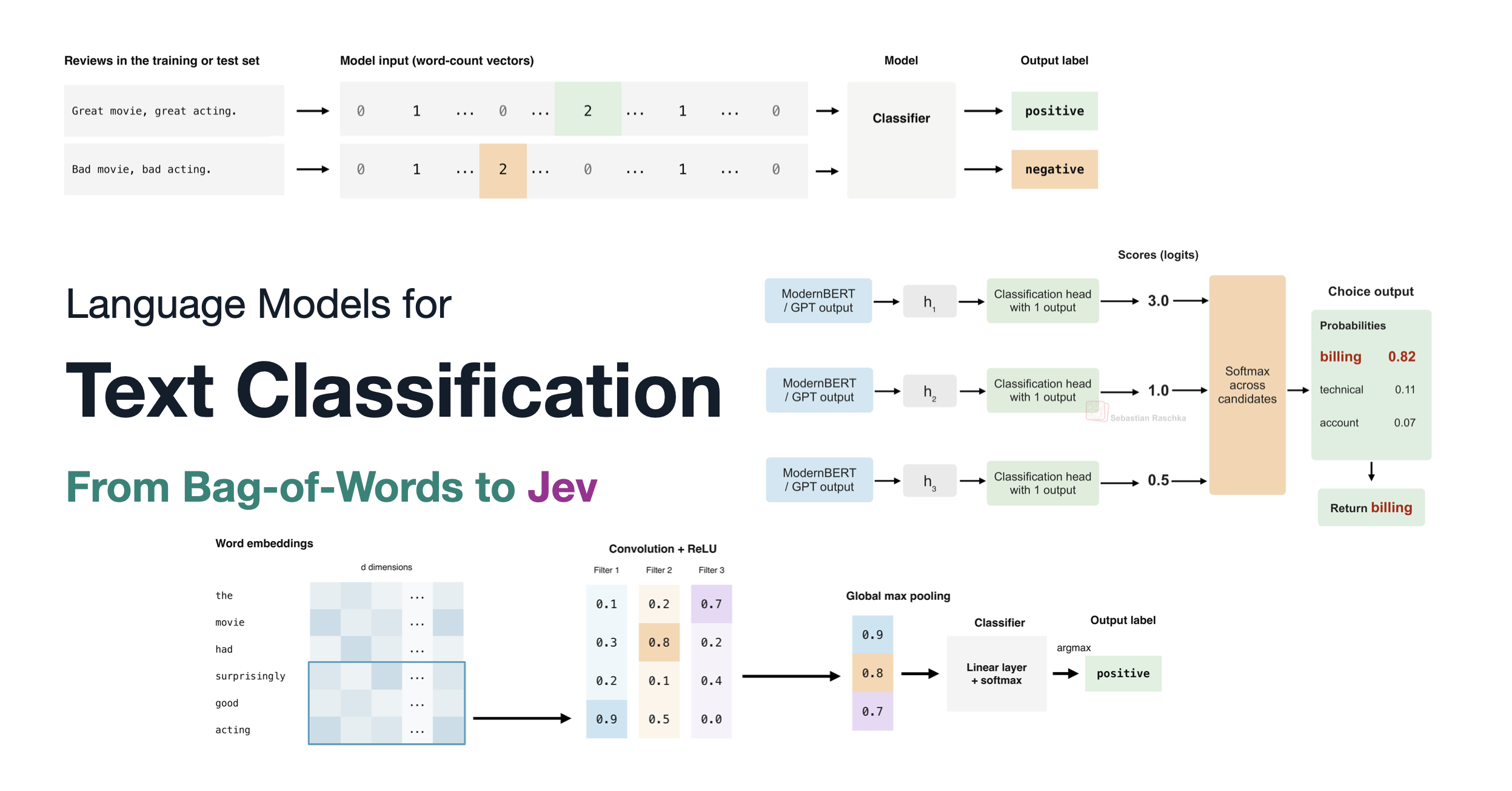
Language Models for Text Classification: From Bag‑of‑Words to Jev
An overview of how text classification has evolved and why the newly released Jev model is generating buzz.
---
1. From Simple Counts to Word Embeddings
Before the transformer era, most text classifiers relied on bag‑of‑words (BoW) representations. By turning a document into a fixed‑length vector of word frequencies (or TF‑IDF scores), classic algorithms such as Naïve Bayes, logistic regression, SVMs, and tree‑based models (e.g., XGBoost) could be applied directly. BoW is cheap, fast, and surprisingly effective for tasks where a handful of keywords dominate the decision—spam detection, news categorization, or sentiment analysis on modest datasets.
The main drawback is the loss of word order: the sentences "the dog bites the man" and "the man bites the dog" become identical vectors. Extensions like n‑grams partially mitigate this but at the cost of a dramatically larger vocabulary.
Word embeddings introduced a richer representation. Instead of counting words, each token is mapped to a dense vector (e.g., Word2Vec, GloVe) that captures semantic similarity. Embeddings can be learned offline or as part of a neural network, and they serve as the input for more sophisticated architectures that preserve sequence information.
---
2. Neural Networks that Respect Order
2.1 Recurrent Neural Networks (RNNs)
RNNs process text token‑by‑token, maintaining a hidden state that summarizes everything seen so far. Variants such as LSTM and GRU add gating mechanisms to alleviate the vanishing‑gradient problem, allowing the model to retain information over longer spans. While RNN‑based classifiers can capture word order, they are computationally intensive because each step depends on the previous one, limiting parallelism.
2.2 Convolutional Neural Networks (CNNs)
CNNs treat a sentence as a one‑dimensional image, applying filters that slide over n‑gram windows. They excel at detecting local patterns (e.g., key phrases) and can be trained quickly thanks to parallel convolution operations. However, they still lack a global view of the entire sequence.
2.3 The Transformer Leap
The 2017 transformer architecture replaced recurrence with self‑attention, enabling each token to attend to every other token in a single pass. This design dramatically improves parallelism and captures long‑range dependencies, leading to state‑of‑the‑art performance on a wide range of NLP tasks, including classification.
---
3. Enter Jev: A General‑Purpose Text Classifier
Jev is a newly released model that positions itself between heavyweight, general‑purpose LLMs and narrow, hand‑crafted classifiers. Its key selling points are:
- Speed & Cost: Jev runs inference orders of magnitude faster than full‑scale LLMs, making it attractive for high‑throughput applications.
- General‑Purpose API: Users can submit a prompt describing the classification task (e.g., "Classify the sentiment of this review") and receive a label without fine‑tuning a model for each new domain.
- Competitive Accuracy: For many well‑defined problems, Jev matches or exceeds the performance of bespoke models, especially when the training data are limited.
- Calibration: Jev provides confidence scores that are better calibrated than many off‑the‑shelf LLMs, helping downstream systems make risk‑aware decisions.
Because Jev abstracts away the model architecture, developers can focus on problem definition rather than feature engineering or model selection. In practice, this means a typical workflow looks like:
- Define the label set (e.g., spam vs. non‑spam, positive vs. negative sentiment).
- Craft a concise instruction for Jev, optionally providing a few examples (few‑shot prompting).
- Send the text to Jev’s API and receive a label plus a confidence score.
If the task is extremely narrow—say, detecting a specific keyword pattern—a custom lightweight model (logistic regression on BoW, a tiny CNN, or a rule‑based system) may still be cheaper. Jev shines when the problem requires flexibility across domains or when rapid prototyping is essential.
---
4. When to Choose Classic Methods vs. Jev
| Scenario | Recommended Approach | |----------|----------------------| | Very small dataset, clear lexical cues | BoW + logistic regression or a small decision tree (fast to train, easy to interpret). | | Moderate dataset, need to capture phrase patterns | CNN or RNN with pretrained embeddings (balance between speed and expressive power). | | Large, heterogeneous data or frequent task changes | Jev’s API (no training, instant adaptation, calibrated probabilities). | | Strict latency or on‑device constraints | Tiny transformer or distilled model fine‑tuned for the specific task. |
The takeaway is that no single method dominates; the choice depends on data size, latency requirements, and how often the classification task changes.
---
5. Practical Takeaways
- Start simple: A BoW + logistic regression baseline is quick to implement and often surprisingly strong.
- Upgrade wisely: Move to embeddings and RNN/CNN architectures when word order or context matters.
- Leverage transformers: For high‑accuracy needs and abundant data, fine‑tune a transformer or use a service like Jev for rapid deployment.
- Mind calibration: Confidence scores matter for downstream decision pipelines; Jev’s calibrated outputs can reduce downstream errors.
- Cost vs. performance: Weigh inference cost against accuracy gains; Jev offers a sweet spot for many real‑world applications.
---
Conclusion
The journey from bag‑of‑words to modern transformer‑based classifiers illustrates a steady trade‑off between simplicity, speed, and expressive power. Jev encapsulates the latest advances—fast inference, a flexible API, and well‑calibrated predictions—making it a compelling option for practitioners who need a ready‑to‑use classifier without the overhead of training and maintaining bespoke models. By understanding the strengths and limits of each generation of techniques, you can select the right tool for any text‑classification challenge.
Source
Read original sourceWhy we picked this
Detailed guide on language models for classification, core AI tool