Deep dive into Azure Maia 300 architecture
Azure Maia 300 combines a software‑defined dataflow architecture, NUMA chiplet design, and a unified super‑pod network to deliver up to 2.5× more performance per watt for large‑language‑model inference.
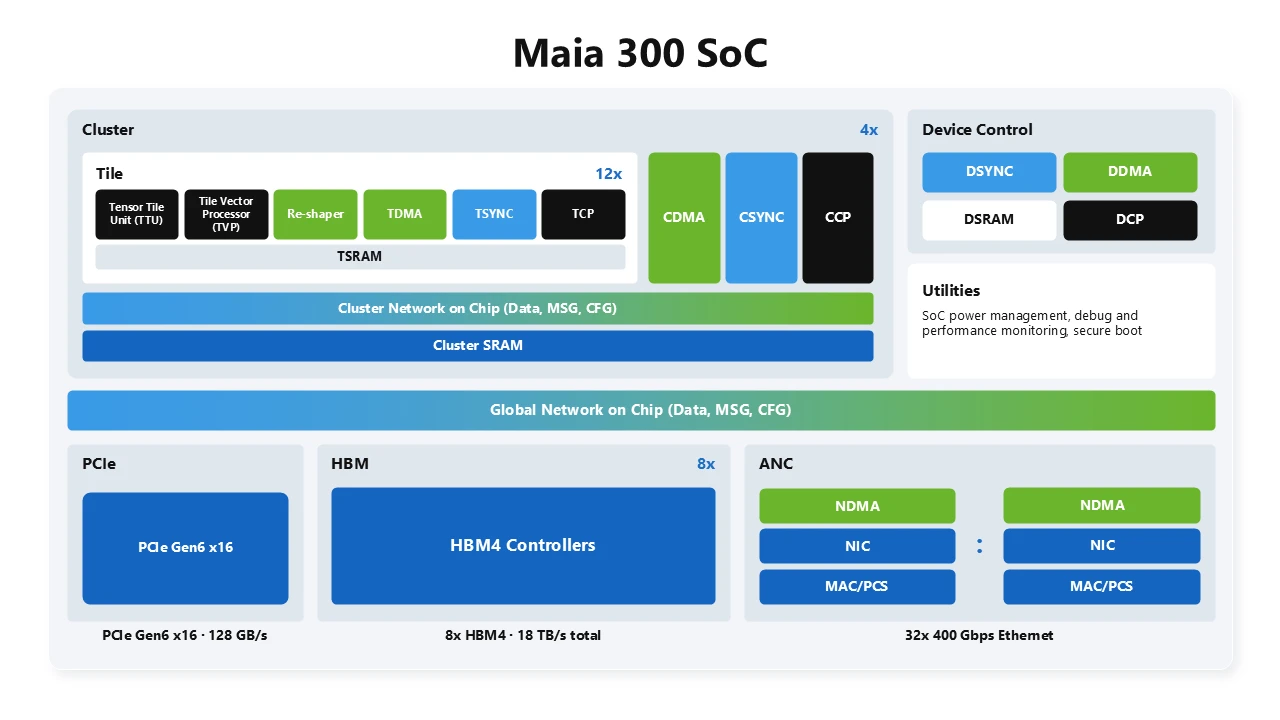
Deep Dive into Azure Maia 300 Architecture
Azure Maia 300 is Microsoft’s third‑generation AI accelerator platform, engineered from the ground up to maximize the efficiency of large‑language‑model (LLM) inference. By tightly co‑designing silicon, software, rack layout, and networking, Maia 300 tackles the unique demands of agentic workloads—long‑context decoding, multi‑step execution, and tool use—while keeping power and cooling within a fixed datacenter envelope.
---
1. Software‑Defined Locally Accessed Dataflow (SDLA)
Maia 300 builds on the SDLA concept introduced with Maia 200. The architecture separates the control path (software‑defined orchestration) from the data path (hardware execution). This separation lets developers explicitly manage:
- Data placement across on‑die SRAM, high‑bandwidth memory (HBM4), and chiplet‑local DRAM.
- Movement and conversion using DMA engines and dedicated data‑type conversion units.
- Synchronization across compute engines and the network‑on‑chip.
By giving software direct control over where each token lives and how it moves, Maia 300 reduces unnecessary traffic, cuts latency, and improves the useful‑tokens‑per‑watt metric that drives cost‑effective AI services.
---
2. Chiplet‑Based NUMA SoC
The Maia 300 system‑on‑chip moves from a uniform memory access (UMA) layout to a non‑uniform memory access (NUMA) organization spread across multiple chiplets:
- Compute chiplets fabricated on TSMC N2P for the best performance‑per‑watt.
- Memory‑controller chiplets hosting eight HBM4 stacks (288 GB total, 18 TB/s bandwidth per accelerator).
- I/O chiplets optimized for high‑speed networking.
This division allows each compute region to access nearby memory, cutting data‑travel distance and energy. The result is a 36 % increase in FLOPs, 2.5× higher HBM bandwidth, and a 14 % boost in scale‑up bandwidth compared with Maia 200.
---
3. Precision‑Optimized Inference
Maia 300 introduces enhanced MXFP4 and sub‑3‑bit storage formats. Narrower representations shrink the memory footprint of each token, enabling:
- Larger models and longer context windows within the same power budget.
- More concurrent inference sessions per accelerator.
- Faster data movement due to fewer bytes transferred.
The vector engine’s ISA enhancements also add specialized kernels for softmax, low‑precision casting, and other common inference operations, further tightening the compute‑to‑data ratio.
---
4. Unified Super‑Pod Fabric
Scaling from a single rack (96 accelerators) to a super‑pod of up to 12,288 accelerators is achieved with a single, software‑transparent network fabric:
- In‑rack topology mixes direct electrical links between neighboring accelerators with a switched fabric that connects all 96 units.
- Second‑tier optical switches link up to 128 racks, extending the fabric across the super‑pod.
- One communication model lets any accelerator address any other accelerator directly, without host mediation.
Latency is tiered: direct pairs (lowest), intra‑rack (one hop), inter‑rack (up to three hops). Bandwidth allocation is dynamic—accelerators can draw up to 750 GB/s from peers when cross‑rack traffic is limited, allowing flexible job packing and efficient use of spare capacity.
---
5. Rack‑Scale Deployment Efficiency
At datacenter scale, Maia 300’s rack design co‑optimizes:
- Server density and airflow to fit within existing cooling limits.
- Power distribution that matches the chiplet’s mixed‑process technology.
- Telemetry for real‑time power and performance monitoring.
These measures deliver up to 2.5× more performance per watt than the previous generation, translating into lower operational costs for Azure services such as Microsoft Copilot, GitHub Copilot, and Microsoft Foundry.
---
Practical Takeaways
- For developers, the SDLA model means you can write inference pipelines that explicitly stage data where it will be consumed, reducing latency and cost.
- For architects, the NUMA chiplet layout and unified fabric simplify scaling from a single rack to a super‑pod without redesigning software stacks.
- For business decision‑makers, Maia 300’s efficiency gains directly improve the economics of deploying LLM‑driven applications at cloud scale.
By aligning silicon, software, and system design, Azure Maia 300 sets a new benchmark for energy‑efficient, high‑throughput LLM inference—an essential foundation for the next wave of AI‑powered services.
Source
Read original sourceWhy we picked this
Deep dive into Azure Maia 300 architecture highlights agentic inference hardware, core AI content.