AI transformation across the infrastructure lifecycle: From supply chain to fleet operations
AI is reshaping Azure’s entire infrastructure lifecycle—from supply‑chain planning to self‑healing fleet operations—by linking data, streamlining decisions, and keeping human judgment central.
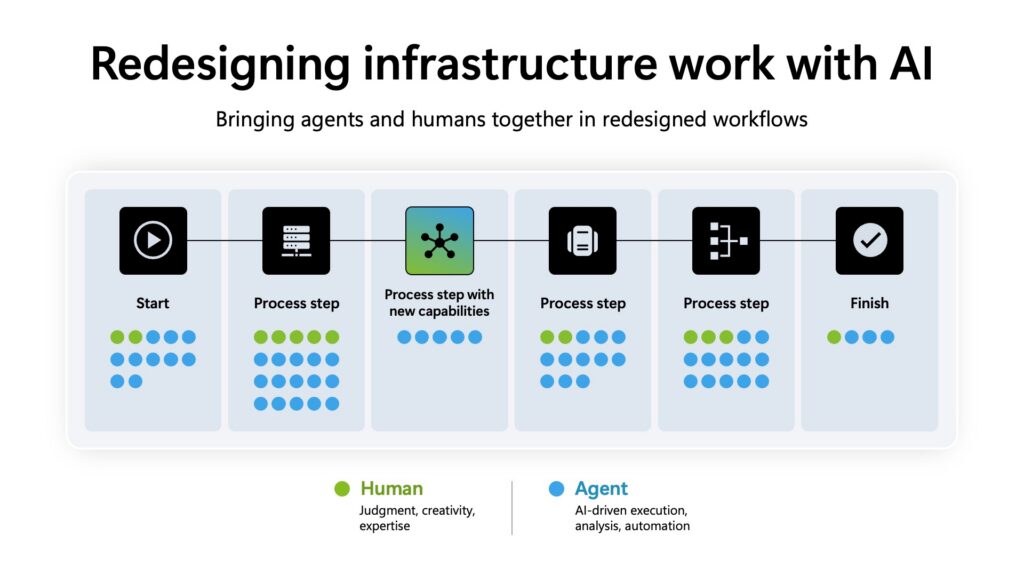
AI‑Driven Evolution of Azure’s Infrastructure Lifecycle
Microsoft’s Azure hardware ecosystem spans design, supply‑chain, deployment, and fleet management across more than 80 regions. By embedding AI throughout this lifecycle, Azure turns isolated processes into a continuous learning loop where insights from one stage inform the next, while human expertise remains the final arbiter.
1. Start with the Work, Not the Tool
The first lesson was to map and simplify existing workflows before layering AI. Demand‑planning teams, for example, historically reconciled data from multiple systems, turning a single investigation into a multi‑day effort. Rather than immediately adding an agent to a fragmented process, Azure’s teams built a shared, governed data foundation and identified decision points where human accountability was essential. This “Lean before AI” mindset ensured that any automation would amplify, not merely accelerate, the underlying work.
2. Multi‑Agent Workflows Accelerate Decision‑Making
With clean data pipelines in place, Azure introduced multi‑agent assistants that ingest signals such as installed‑base shifts, regional demand spikes, and decommissioning schedules. The agents surface what changed, where, and why, compressing a five‑to‑seven‑day analysis into minutes. Across several planning cycles, manual effort dropped roughly 50 % and cycle time fell up to 75 % for targeted workflows. Similar agents now aid:
- Fulfillment: Consolidating rack‑delivery blockers and supply compatibility, cutting investigation time by ~55 %.
- Logistics: Evaluating air, land, and sea routes for cost, speed, and carbon impact, while forecasting emissions.
These tools free engineers to focus on contextual judgment rather than data gathering.
3. Closing the Learning Loop Across the Fleet
Once hardware is deployed, Azure shifts from reactive firefighting to proactive, self‑healing fleet management. AI models continuously ingest telemetry from millions of nodes, flagging emerging failure patterns and predicting hardware faults days in advance. Early results include:
- A 92 % reduction in disk‑related VM interruptions.
- 53 % faster repair of out‑of‑service nodes.
- Up to 40 % fewer out‑of‑service rack repairs thanks to three‑day advance warnings.
Crucially, engineers retain oversight, approving actions and preserving context (assignment, outcome, next steps) for future analysis. This recorded history feeds back into upstream stages—informing demand planning, sourcing decisions, and even silicon design—creating a virtuous cycle of improvement.
4. Lessons from Missteps
Early experiments that applied AI to isolated fragments revealed a key pitfall: speed without end‑to‑end benefit. An agent might produce output faster, but if downstream teams still needed to reformat or reconcile that output manually, overall workflow efficiency did not improve. Success metrics therefore shifted from task‑level gains to workflow‑level impact, measuring reduced handoffs, eliminated rework, and enhanced decision quality.
5. The Road Ahead
Azure’s AI transformation is moving toward integrated, multi‑agent orchestration that spans bill‑of‑materials generation, capacity delivery, spare‑parts management, and sales‑operations execution. The goal is an intelligent operating system where:
- Data is seamlessly connected across the hardware lifecycle.
- AI surfaces evidence instantly, allowing humans to apply context and judgment.
- Outcomes are captured and fed forward to refine future designs and supply‑chain strategies.
By keeping humans in the loop and focusing on holistic workflow redesign, Azure demonstrates how AI can evolve from a speed‑boosting add‑on to a strategic catalyst for resilient, adaptive infrastructure.
--- This article synthesizes the key themes from Azure’s AI‑driven infrastructure journey, highlighting practical takeaways for organizations seeking to embed intelligence across their own hardware lifecycles.
Source
Read original sourceWhy we picked this
Describes AI-driven transformation of infrastructure lifecycle, a meaningful AI application.