AI’s hidden storage bill: What inference leaves behind
AI inference generates massive, often overlooked storage costs that grow faster than compute, demanding scalable, tiered storage strategies.
Introduction
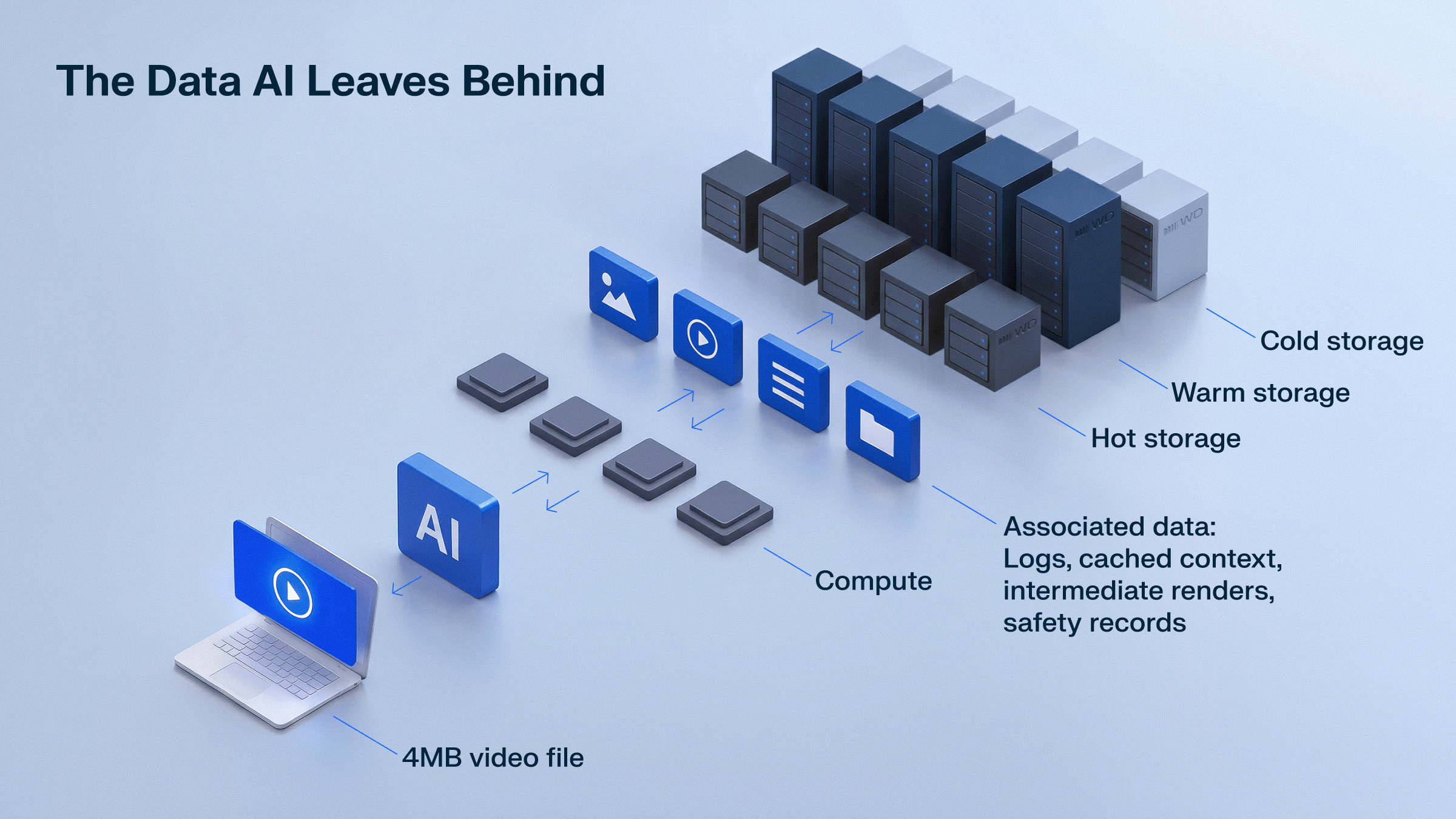
Artificial intelligence is often framed as a compute‑heavy problem: GPUs, accelerators, and power draw dominate the conversation. Yet every inference request leaves behind data—logs, cached context, intermediate renders, safety records—that must be stored. As inference scales, this hidden storage bill can quickly outpace compute budgets, turning what was once a "rounding error" into a major expense.
The Growing Data Footprint of Inference
Inference runs continuously, unlike the finite training cycles that are easier to budget. Each AI‑generated output, especially rich media like video, creates a disproportionate amount of back‑end data. Internal measurements show an 8‑second 720p clip (3.97 MB) can generate over 500 MB of associated storage, a 130× increase. When enterprises produce longer, higher‑resolution content, the storage demand balloons into hundreds of gigabytes per clip.
Industry forecasts reinforce the trend: AI inference demand is projected to grow at a 35 % compound annual growth rate through 2030, outpacing training growth (22 %). A recent survey of 763 IT leaders found 95 % reporting increased data volumes from generative AI, with 61 % seeing growth of 25 % or more in the past year. The result is a storage spend that can rise 25 % year‑over‑year, potentially eclipsing the more predictable compute budget.
Matching Storage to the AI Data Lifecycle
The nature of AI data changes the role of storage:
- Retention: Model logs, synthetic outputs, and inference results accumulate and are rarely discarded.
- Reuse: Archived data increasingly feeds retrieval‑augmented generation (RAG) and future model training.
- Performance: While hot data still needs low‑latency access, the bulk resides in warm, cool, or cold tiers.
Enterprises therefore need a tiered architecture that balances performance with capacity. Hard‑disk drives (HDDs) remain cost‑effective for massive, less‑frequently accessed datasets, offering a significant cost‑per‑terabyte advantage over flash. Meanwhile, SSDs and NVMe tiers handle the hot workloads that keep GPUs fed without idle time.
Budgeting Beyond Compute
For CFOs and CIOs, the traditional "AI infrastructure spend" line item—focused on GPUs—misses the storage side‑effect. A model that idles waiting for data can cost as much as one waiting for a GPU, yet the storage bottleneck often surfaces only as higher operating expenses and retrieval delays.
Consider two use cases:
- Retailer generating product videos: Compute cost per video is predictable, but each video adds hundreds of megabytes of backend data that must be retained for future marketing or analytics.
- Insurer using RAG for claims: Each processed document incurs storage for the original claim, extracted entities, and model outputs, compounding over time.
If storage is treated as a negligible add‑on, its cumulative cost can become a sizable fraction of the AI program’s total spend within 12–18 months—precisely when leadership evaluates expansion.
Building Economically Scalable Capacity
Addressing the hidden storage bill starts with three critical questions:
- What is our data retention policy for AI‑generated content, and who defines it?
- Is our storage procurement aligned with the full AI data lifecycle, not just training‑time performance?
- If AI usage doubles next year, will storage costs double, or grow faster?
Enterprises should adopt a storage strategy that:
- Implements tiered tiers (hot, warm, cool, cold) with appropriate power, reliability, and density characteristics.
- Treats archives as active assets for RAG and future inference, rather than dormant backups.
- Sets retention policies based on strategic value, not merely on initial cost.
By planning storage as a first‑class component of AI infrastructure, organizations can avoid surprise cost overruns and ensure that GPUs remain productive rather than idle.
Conclusion
AI inference’s hidden storage bill is real and growing faster than compute. Recognizing and budgeting for this data lifecycle—through tiered, economically scalable storage—will be essential for enterprises that want to sustain AI initiatives without unexpected cost spikes. Address the three guiding questions now, and align storage procurement with the full lifespan of AI‑generated data before the next budget cycle arrives.
Source
Read original sourceWhy we picked this
Discusses AI inference storage costs, a core AI infrastructure issue